


The Nomadic Bedouins Who Rule the World 2
- Fady Philip

- Aug 10, 2025
- 10 min read
While in the first part we followed how Jewish identity was formed through narrative, myth, and historical selectivity, in this second part, we begin to explore the mechanisms that enabled this identity to translate itself into real influence. The narrative alone was not enough; soft power took over the task: media, education, capital, and transnational legislation.
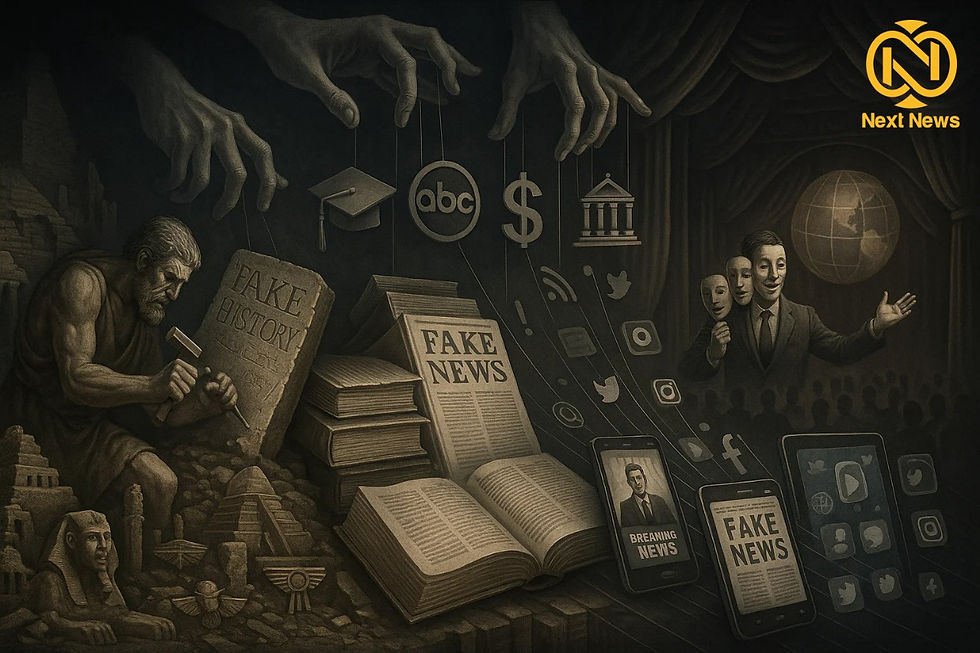
In this part, we will monitor with numbers, names, and influence how the presence of these groups has become dominant in the joints of global politics, economics, and culture. We will also analyze how the narrative itself has turned into a tool of oppression for anyone who tries to ask uncomfortable questions, under the banner of a ready-made accusation: "anti-Semitism."
Chapter Three: The Creation of the Eternal Victim
The Holocaust was the most dangerous turning point. While anti-Semitism in Europe was nothing new, the political exploitation of the Holocaust was unprecedented. This is where the idea of "Jewish exceptionalism" began to take shape: the idea that the suffering of the Jews is different from the suffering of any other people, and must be compensated unconditionally, and that criticism of Israel or Judaism is necessarily anti-Semitism.
Thus, a real tragedy was transformed into a political tool, used to silence any critical discourse, and to justify all policies of occupation, settlement, and ethnic cleansing.
1. The Holocaust as a Source of Power and Un-criticizability
In 2000, the scholar Norman Finkelstein published his book, The Holocaust Industry, in which he analyzes how what is known as the "Holocaust industry" has become a means of exploiting the suffering of the Jewish people for financial and political benefits, and for cultivating an "industrial memory" that is not allowed to be questioned.
“Another historical irony: there were times in Europe when anyone who argued that all Jews belong to a nation of alien origin would have been classified at once as an anti-Semite. Nowadays, anyone who dares to suggest that the people known in the world as Jews … are still not a people or a nation is immediately denounced as a Jew-hater.”
— Shlomo Sand
This quote highlights how the idea of the "eternal victim" has become a red line; any challenge to it is considered legitimizing anti-Semitism.
2. Investing the Tragedy to Legitimise Modern Policies
The story of the Holocaust has turned from a tragic human event into a legitimate tool used to justify policies and to impose immunity from criticism. For example, in 2024, the "Voices of Israel" project (formerly "Kela Shlomo") is funded by the Israeli government with $8.6 million to re-frame the concept of "anti-Semitism" in the United States, so that it includes any criticism of Israel under that accusation, which raises controversy about the limits of freedom of expression and the impact of foreign political activity.
3. The Holocaust: From Tragedy to a Psychological Pressure Button
The shift from legitimate political criticism to a "stigma" wielded against critics is an unprecedented psychological and political transformation. In the academic context, debate about the Palestinian-Israeli conflict has been restricted under the umbrella of "anti-Semitism," whether in universities or the media, which makes talking about the balance of power and political governance difficult, as the speaker becomes a "forgiven victim."
4. Global Laws Criminalising Holocaust Denial
Today, there are 18 countries that legally punish those who deny the Holocaust, including: France, Germany, Russia, Israel, Canada, and India. The European Union is seeking to establish unified legal frameworks that criminalize denial or minimization of the massacres, as part of a broader plan to combat racism and ethnic cleansing.
5. Global Rise in Anti-Jewish Sentiment and Harassment
According to a 2024 ADL-Ipsos poll that included over 58,000 people from 103 countries, the percentage of people with anti-Semitic attitudes rose from 26% in 2014 to 46% in 2024. The highest percentages are in the Middle East and North Africa (75%).
Pew Research Center reports showed that Jews were subjected to harassment in 94 countries in 2020, compared to just 51 countries in 2007, despite making up about 0.2% of the world's population. In Europe, a FRA study found that more than 90% of Jews feel that anti-Semitism is on the rise, while 38% are considering emigration for fear of threats.
6. Political Exploitation of Rigidity Towards Criticism
Some countries have launched effective diplomatic initiatives, including special positions to combat anti-Semitism in 24 countries, through the SECCA forum of the World Jewish Congress. A prominent example: In 2024, Australia appointed Jillian Segal as the first Special Envoy for Combating Anti-Semitism, to strengthen legal measures against hate crimes in the community.
• The actual Holocaust is an indispensable human event, but the political monopolization of its memory becomes a tool for controlling truth even within the public sphere.
• The conversion of the store of evidence into an immunity from criticism, and even a weapon against those who try to place the issue in a broader context.
• This construct makes it difficult to hold modern policies accountable, because the discussion is prematurely canceled with the ready-made image of "anti-Semitism."
• The data indicates a tangible rise in the phenomenon of hostility against Jews, in contrast to the expansion of Jewish institutions around the impact of this phenomenon, and its transformation into influential political tools.
Chapter Four: Soft Control
Perhaps the most dangerous thing produced by the modern Jewish project is not military power, but soft power: media, money, education, and cultural influence.
In the media: Jewish figures have wide influence in major networks (CNN, New York Times, Hollywood). In finance: Jewish banks and financial companies control the policies of the global economy. In education: Jewish academics control think tanks and major universities (Harvard, Stanford, etc.).
Thus, the Jewish narrative has become "globalized," exported as an absolute truth, and anyone who dares to question it is punished.
1. Media: The Widest-Spreading Hidden Influence
Out of 60 senior executives in major Hollywood studios, artistic unions, and talent agencies, 50 of them are Jewish or married to Jews (83%), even though Jews represent only about 2% of the US population. This constitutes a representation that exceeds the population ratio by about 41.5 times.
Out of 93 prominent executives in American television media, 74 of them are Jewish or married to Jews, a percentage of 79%, while Jews constitute only about 2% of the population—a representation that exceeds the population ratio by 39.5 times.
Prominent names with Jewish backgrounds include:
• Jeff Zucker (former head of NBC Universal)
• Steven Spielberg and Jeffrey Katzenberg (founders of DreamWorks)
• David Geffen, Mike Eisner (Disney)
Influential contemporary media figures:
• David Iffon - a candidate to buy The Telegraph, known for his conservative support and his revival of the role of traditional media.
• Dennis Prager - founder of PragerU, a famous radio host and broadcaster known for his political interpretations from a conservative perspective.
In other media fields:
• Television: 57 out of 64 executives, a percentage of 89%, a representation of 44.5 times.
• Newspapers and Magazines: 42 out of 65 belong to Jews or their partners, a percentage of 65%, exceeding the population ratio by 32.5 times.
• Music Industry: 39 out of 50 officials, a percentage of 78%, with a difference of 39 times.
In addition, the American media includes figures such as Peter Chermin (News Corp), Michael Schulhof (Sony), David Geffen, Jeffrey Katzenberg, and Steven Spielberg of DreamWorks—all a prominent Jewish entity.
Joel Stein, a Hollywood writer, said in fascination:
"Yes, we control Hollywood. It doesn't matter if everyone thinks we run the media, Wall Street, or the government... The important thing is that we continue to lead."
2. YouTube and Alternative Media: Prominent Direct Voices
Jewish YouTube channels with hundreds of thousands of subscribers:
• Two Jews Comedy: 795,000 subscribers.
• Jewish Learning Institute: 433,000 subscribers.
• JNS TV: 184,000 subscribers.
Digital influencers:
• Mandana Dayani - activist, appeared on MSNBC and UN, her videos about the October attack on Israel garnered about 50 million views. She was appointed by the Biden administration to the National Holocaust Memorial Council.
• Elad Nehorai - blogger and cultural-political activist who appeared in the Guardian and HuffPost and has influence in contemporary Jewish literature.
• Bethany Mandel - coded among the most prominent conservative voices, has remained influential in journalistic and political platforms.
Communities such as the Jewish Media Awards in New York celebrate positive representation in television and cinema, such as shows like "Fauda" and "The Patient."
3. Money: From Historical Families to Today's Billions
The Rothschild family—a pioneer in international finance from the late eighteenth century—played a pivotal role in financing the Napoleonic Wars and developing transport and energy, and was considered one of the most important financial families in history.
According to Forbes Israel (2025), there are 465 Jewish billionaires in the world, with a total net worth of up to $2.66 trillion.
Contemporary examples:
• Miriam Adelson: Israeli-American, her fortune is estimated at $29.5 billion, she co-owns «Las Vegas Sands» and the newspaper Israel Hayom.
• Noam Gottesman: one of the founders of GLG Partners, on the Forbes 400 list with a fortune estimated at $2.4 billion.
• Joseph Safra: a banker of Lebanese-Syrian origins, one of the richest bankers in South America.
Comments such as the discussion of one-third of America's richest people having Jewish origins despite their small representation of the population confirm the extent of wealth concentration in the hands of a small few (about 0.2% of the world's population).
4. Education: The Leading Mind Behind Texts and Thought
In the early 1970s, 25% of university professors at "Ivy League" universities were Jewish, according to Dr. Lipset at Harvard. Today, the representation rate of Jewish students in universities such as Harvard is between 9.9%, Columbia 22.3%, and Yale 12.2%—even though Jews constitute ~2% of the general population. However, there is a clear decline: under the age of 30, the percentage of prestigious Jewish researchers falls to only 4%, compared to 21% of the Boomer generation.
• Media: Jews have a huge and disproportionate representation in leadership positions compared to their population.
• Money: A huge concentration of wealth in the hands of an elite of Jews—from Rothschild to today's billionaires.
• Education: Intellectual influence is strong, but there is a gradual demographic shift in favor of a minority.
Field Jewish Representation in Positions of Influence Ratio Difference
Media 79% of executives +39 times
Money Historical families + billionaires High wealth concentration
Education Elite universities +5-10 times
Digital Media Large channels and influencers Wide public reach
These elements show how the fame of the Jews was transformed from a narrative into a real institutional and network structure, possessing the tools of soft influence—media, economics, and thought—this trinity that formed the backbone of their global influence.
Narrative as a Tool of Control
What distinguishes the Jewish experience is its success in overturning concepts: from a people without a homeland to a global network of influence, from a victim to an authority beyond criticism, from a fragmented identity to a meticulously crafted one.
1. Political Narrative: Controlling the Past to Control the Future
Narrative is not just stories told, but a strategic tool for shaping reality, as political communication researchers say: it enables the elite to "give a specific meaning to the past, present, and future" with the aim of justifying and legitimizing policies. As George Orwell's novel 1984 taught us, "He who controls the past controls the future."
2. National Myths as Legitimate Cargo
Modern national identity is often built on a founding myth; as the pioneer of nationalism, Benedict Anderson, noted in Imagined Communities, nations are just "imagined communities" that shape themselves through narratives that connect a large number of unfamiliar players. These narratives portray historical events as essential axes, and create a fictional continuity, so they are stronger than mere fatalistic historical narratives.
3. Activating the National Narrative: The Holocaust and the Narrative of "Reviving Israel"
In the Israeli media, the Holocaust is used as a basis for framing reactions to terrorist attacks. A study titled The Narrative Role of the Holocaust… indicates that the Israeli press always invokes this narrative to present the attacks as an extension of an ancient existential conflict.
4. Narrative as Digital and Mental Control in the World
In the modern era, with the rise of social media, narrative has turned into a tool of digital manipulation. In the recent Gaza crisis, Israeli institutions resorted to publishing intense politicized content on platforms such as Twitter and Facebook, using social networks to attract public opinion and form a "cognitive framework" that serves the official narrative without challenge.
5. Resistance Narratives: Counter-Examples
Dominant narratives are not flexible; opposing narratives are often silenced by branding them as "anti-Semitism," even if a local Jewish person who expresses support for Palestinians is accused. The latest example, the expression across the Sydney National Bridge, is considered an attempt by a part of the media to portray Israel as a "colonial state," which was considered a transgression of the acceptable narrative.
Narrative is not just words, but an effective weapon of control. Through the invention of narratives, the past is reshaped, the present is manipulated, and the permissible future is formulated.
In the Jewish case, the founding narrative—from the expulsion from Egypt to the Holocaust and the establishment of Israel—has transformed into open cultural, economic, and political waterfalls, through which the same narrative flows that provides immunity against criticism and grants power at the same time.
And the most important question: How do we read narratives accurately, do we really repeat them or do we free ourselves from them? And can the false narrative, written on the ruins of history, be broken? Understanding this will free us from repeating history, not only towards the Jews, but towards any nation that builds itself on a mythical narrative, without criticism or reporting.
Finally, this is not an article about Jews only, but about the power of narrative: How do nations create their mental images? How is history re-produced to serve the present?
And understanding these mechanisms not only frees us from repeating history, but gives us tools to understand the world as it is, not as we are meant to see it.
______________
Sources
1. Books and academic studies:
o Anderson, Benedict. Imagined Communities: Reflections on the Origin and Spread of Nationalism. Verso Books, 1983.
o Shenhav, Yehouda. The Arab Jews: A Postcolonial Reading of Nationalism, Religion, and Ethnicity. Stanford University Press, 2006.
o Sand, Shlomo. The Invention of the Jewish People. Verso Books, 2009.
o Wistrich, Robert S. A Lethal Obsession: Anti-Semitism from Antiquity to the Global Jihad. Random House, 2010.
o Said, Edward. Orientalism. Vintage Books, 1978.
o Pappe, Ilan. The Ethnic Cleansing of Palestine. Oneworld Publications, 2006.
2. Articles and scientific studies:
o “The Narrative Role of the Holocaust and the State of Israel in the Coverage of Salient Terrorist Events in the Israeli Press.” ResearchGate
o “Hasbara and the Control of Narrative: An Element of Strategy.” Middle East Policy Council
o “Politics of Memory.” Wikipedia - Politics of memory
o “Les récits politiques comme instruments de domination.” OpenEdition Journals – TIPA
o “Narrative Politics in National Identity.” Redalyc
o “Historical Memory and the Construction of National Identity.” SciELO Brazil
3. Reports and media platforms:
o “Making a National Icon a Symbol of Antisemitism is a Bridge Too Far.” The Australian
o “How Antisemitism Became a Catch-All to Silence Israel’s Critics.” TIME Magazine
o “Why Israel Always Plays the Holocaust Card.” Haaretz
o “Israel’s PR Campaigns on Social Media.” The Guardian
o “Jewish Influence in American Media and Politics.” Council for the National Interest (CNI)
4. Databases and statistics:
o ADL Global 100: An Index of Anti-Semitism. Anti-Defamation League (ADL)
o Pew Research Center – Religion and Public Life. pewresearch.org
o World Jewish Congress – Jewish Population Worldwide. worldjewishcongress.org
o OECD – Educational Attainment and Literacy Rates by Country. data.oecd.org
o Forbes – World's Billionaires List (with ethnicity filters). forbes.com


Comments