


Warsaw Forum Rallies Against Russia, While Moscow Downplays Threat and Warns of Europe's 'Weakness and Identity Loss'
- Next News
- Sep 29, 2025
- 2 min read

The "Warsaw Security Forum," hosted by the Polish capital, commenced today with Polish Prime Minister Donald Tusk urging the West to "unite" in confronting Russia over its war in Ukraine. Tusk warned that losing this war would have consequences for the current and future generations across Poland, Europe, the United States, and the world.
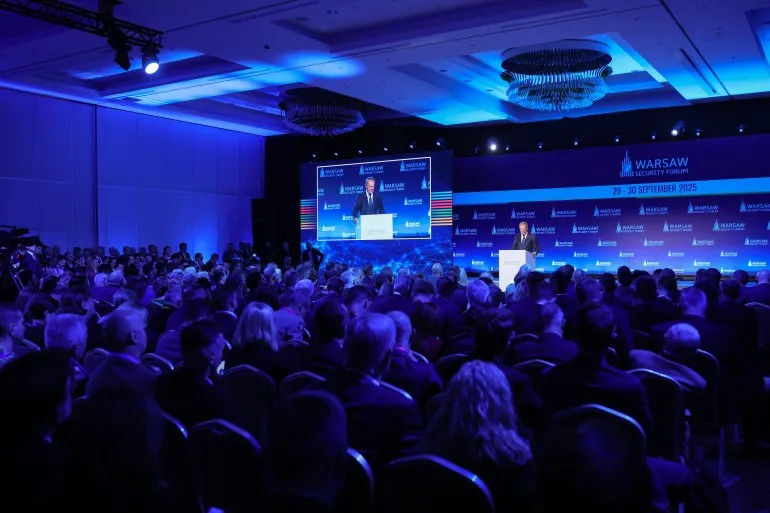
Tusk asserted, "This war is also our war," viewing Russia's aggression as part of a political project aimed at subjugating other nations. He categorically ruled out any idea of compromise with Moscow, stating that the only reasons for surrender would be "weak will, doubt, cowardice, or lack of imagination."
NATO Allies Warn of Escalating Russian Threat
German Defence Minister Boris Pistorius echoed Tusk's concerns at the forum, stating that "Russia poses an increasing threat to NATO." Pistorius elaborated that Moscow is "testing NATO allies with increasing frequency and intensity" and that Russian President Vladimir Putin is "deliberately trying to undermine European security and the territorial integrity of European states, and he seeks to provoke NATO member states, wanting to expose weaknesses within our alliance."
The German Minister affirmed that NATO has responded to Russian provocations "with clarity, unity, resolve, and wisdom," stressing that the alliance "will not be drawn into Putin's trap of continuous escalation. We will maintain our calm while remaining steadfast and resolute." Pistorius cited examples of NATO's readiness, such as allied planes in the Baltic States "scrambled and escorted Russian aircraft out of Estonian airspace."
Medvedev Scorns 'Old Cold Europe'
In stark contrast, Deputy Chairman of the Russian Security Council Dmitry Medvedev downplayed the Western mobilization effort, using a derisive tone. Writing on his Telegram channel concurrent with the forum, Medvedev asserted that Russia does not want a war with anyone, particularly Europe, which he called "Old Cold Europe."
Medvedev argued that, in principle, Russia does not need war with Europe, claiming that Europe's "economy is weak and dependent on the United States, and its culture is shamefully decaying. Europe is losing its identity and dissolving into aggressive migrants."
The Russian official deemed European countries "weak and fragmented" and "unable to bear the burden of responsibility for any serious action," adding that their leaders are "petty" and lack "strategic thinking" and the necessary capacity for successful military decisions. He further characterized most Europeans as "lethargic and pampered, unwilling to fight for any shared values, not even for their own land."
Medvedev concluded with a cautionary note, suggesting that war remains possible due to "inauspicious chance" and the "overactive factor of frozen fools." He warned of a "completely real risk for such a conflict to escalate into a war using weapons of mass destruction," urging Russia to be prepared.


Comments