


CNN Exclusive Analysis: Why Trump's Pledge to Defend Qatar is "Exceptional"
- Next News
- Oct 2, 2025
- 3 min read

US President Donald Trump has granted Qatar an exceptional security guarantee that could potentially include military defense, according to an analysis by CNN.
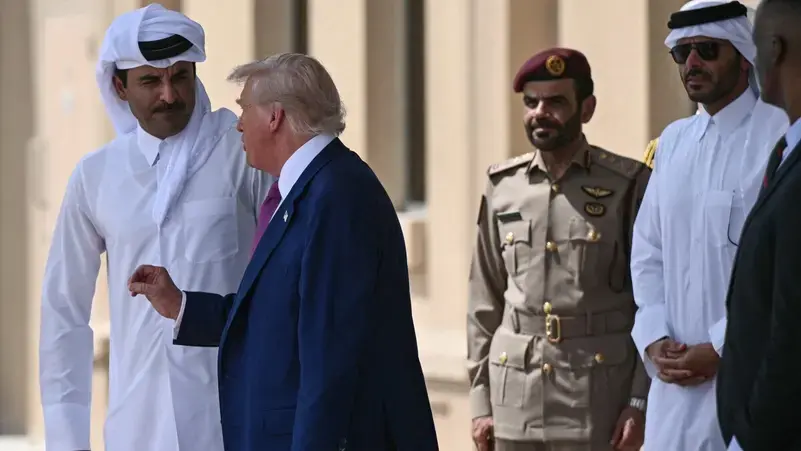
In an executive order issued earlier this week, Trump declared that any attack on Qatari territory, sovereignty, or critical infrastructure would be considered "a threat to the peace and security of the United States." Crucially, the order implies that the US may defend Qatar militarily. It explicitly states that in the event of such an attack, the US "will take all legal and appropriate measures—including diplomatic, economic, and, if necessary, military—to defend the interests of the United States and the State of Qatar, and to restore peace and stability." This represents an extraordinary development in Trump's often-controversial relations with the Middle East for several compelling reasons.
A "NATO-Like" Security Guarantee
The exceptional nature of the executive order stems from its language, which, CNN notes, closely resembles the security guarantee provided by Article 5 of the North Atlantic Treaty Organization (NATO). Qatar is not a NATO member (though the previous administration designated it a major Non-NATO Ally in 2022). Article 5 holds that an armed attack against one member is considered an attack against all, obligating members to assist, including through the use of armed force. Treating attacks on Qatar as threats to the US marks a significant escalation in the relationship with this Arab ally.
The controversial aspect is that Trump is doing this unilaterally through an executive order, which is not a legally binding, ratified treaty—one that would require the approval of the US Senate. This action is essentially a promise made under presidential authority that future presidents would not be obligated to uphold. However, Trump’s bypass of Congress is striking in itself. The Constitution grants the Senate the explicit authority to ratify treaties, yet the President is circumventing Congress on a grave matter that could potentially force the US military into war. Trump has a history of overriding Congress's traditional purview, often succeeding because of the Republican majority’s reluctance to oppose him.
Republican Skepticism and Concerns about Qatar
A key question arises: will Republicans and conservatives in Congress challenge Trump over this executive order concerning Qatar? This is not just about Trump asserting a power traditionally reserved for the Senate, but because he is granting a security guarantee on behalf of a nation many Republicans view with suspicion. Republicans have long complained about Qatar’s alleged human rights abuses and its perceived ties to groups they classify as "terrorist," including the Muslim Brotherhood and Hamas.
These concerns were evident recently when Trump controversially accepted a $400 million Qatari aircraft for use as the new presidential plane. Senator Rick Scott said he "would not fly on a Qatari plane," citing their support for Hamas. Influential right-wing activist Laura Loomer heavily criticized the acceptance, suggesting Trump should instead focus on designating the Muslim Brotherhood as a terror group. It is notable that even Trump himself once expressed deep skepticism, stating in 2017 that "the nation of Qatar has historically been a funder of terrorism at a very high level," urging them to "stop funding radical ideology."
Contradiction with the "America First" Agenda
The security guarantee presents another awkward point: it's not only difficult to reconcile with Trump's decade-old complaints about Qatar's terror funding, but it also clashes with his "America First" agenda. Trump has previously ridiculed the concept of security guarantees, even occasionally hinting that the US might not uphold NATO's Article 5. Conservative commentators, such as Ben Shapiro, criticized the acceptance of the Qatari jet, arguing it was inconsistent with the "America First" slogan.
This move is the latest evidence of Trump's increasing penchant for militarization and openness to, at minimum, threatening to involve the US in foreign conflicts. This guarantee is being made in an extremely volatile region to a country that faced Israeli strikes (targeting Hamas leaders in Doha) less than a month ago and Iranian attacks less than three months ago. This significantly raises the potential that Washington may be called upon to fulfill its promise in a hot conflict zone.
Trump's "Personal" Ties with Qatar
The executive order also shines a spotlight on the controversial personal and family ties between Trump and Qatar—a nation that has clearly sought to curry favour with the US President. The acceptance of the Qatari aircraft is particularly precarious, given Trump's intention to transfer the luxurious plane to his presidential library after his term, rather than it remaining in US government use. Furthermore, the Trump Organization announced plans for a Trump-branded golf resort in Qatar, supported by a company backed by the Qatari sovereign wealth fund.
Trump and his personal businesses have demonstrably blurred the lines between governmental business and personal interests in the Middle East. The executive order concerning Qatar inevitably raises questions about potential personal gain connections and official government actions. Qatar has provided Trump with "exceptional gifts," and now, it appears, he has returned the favour.


Comments